
Introduction: आपके लिए कौन सा better है?
Gym में entry करते ही सबसे common सवाल: compound करें या isolation? अगर आप confusion में हैं—आज की guide आपके लिए final answer है. यहां आपको science-backed explanation, real-life examples, और practical programming मिलेंगे ताकि आप time बचाएं, performance बढ़ाएं, और results fast देखें. आप सीखेंगे:
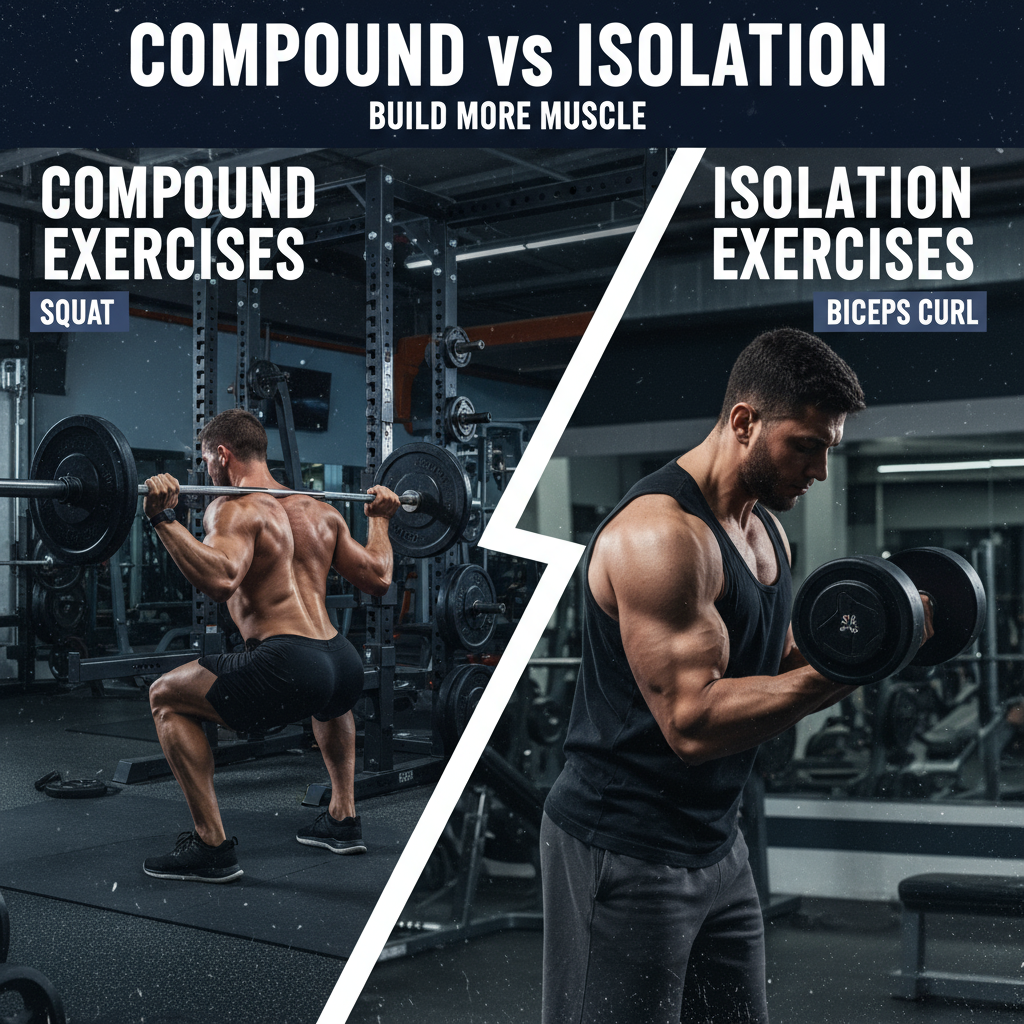
- Compound vs isolation का clear फर्क
- किस goal पर कौन सा focus करना चाहिए
- Sets–reps–rest–RIR जैसे advanced parameters
- Busy schedule, beginners, women, seniors, athletes—सबके लिए ready-to-use plans
Compound Exercises क्या हैं?
Compound यानी multi-joint movements—एक से ज़्यादा joint और multiple muscles साथ काम करते हैं.
- Examples: Squat, Deadlift, Bench Press, Overhead Press, Pull-up/Lat Pulldown, Row, Hip Thrust, Push-up, Dip.
- Benefits:
- High total load → अधिक mechanical tension → strength + muscle दोनों grow.
- Time-efficient: एक exercise से multiple muscles cover.
- Functional carryover: रोज़मर्रा की movements (sit-stand, lift, push, pull) improve.
- Higher systemic stimulus: cardio-respiratory demand भी बढ़ती है.
- Limitations:
- Technique demand high; सीखने में समय लगता है.
- Weak links limit करते हैं (e.g., Bench में triceps/shoulder limit हो सकता है).
- Recovery cost high; fatigue management ज़रूरी.
Isolation Exercises क्या हैं?
Isolation यानी single-joint dominant movements—targeted muscle पर focus.
- Examples: Biceps Curl, Triceps Pushdown, Lateral Raise, Leg Extension, Leg Curl, Calf Raise, Cable Fly, Face Pull, Reverse Fly, Hamstring Curl.
- Benefits:
- Target muscle में mind-muscle connection और metabolic stress high.
- Weak points सुधारने में best.
- Joint-friendly variations available (cables, machines).
- Lower skill demand; beginners भी जल्दी सीख लेते हैं.
- Limitations:
- Time-consuming अगर बहुत सारी isolation करें.
- Systemic strength carryover कम.
- Load usually lower, so overall stimulus per minute कम हो सकता है.
Core Science: Muscle Growth और Strength कैसे बढ़ते हैं?
- Primary drivers:
- Mechanical Tension: भारी weight, controlled tempo, full ROM.
- Metabolic Stress: higher reps, short rests, pumps, occlusion feel.
- Muscle Damage: novelty/lengthened loading से, but control जरूरी.
- Motor Unit Recruitment: compound में high-threshold motor units जल्दी recruit; isolation से specific muscles को और fatigue कर सकते हैं.
- Lengthened vs Shortened Bias:
- Lengthened position (e.g., squat depth पर quads/hips) अधिक hypertrophy से linked पाया गया है.
- Isolation में profile match करके (e.g., incline curl for long head) targeted growth मिलती है.
- RIR/RPE:
- RIR = Reps In Reserve. 0–2 RIR near failure hypertrophy के लिए effective.
- Strength के लिए 2–3 RIR with heavy loads safer and sustainable.
Key Differences (Quick Comparison)
| Aspect | Compound | Isolation |
|---|---|---|
| Joints | Multi-joint | Single-joint dominant |
| Muscles worked | Multiple | One primary |
| Skill demand | Higher | Lower |
| Time efficiency | High | Moderate/Low |
| Load potential | High | Low–Moderate |
| Strength transfer | High | Low |
| Targeted emphasis | Moderate | High |
| Fatigue/Recovery | High systemic | Localized |
| Form complexity | Complex | Simple |
| Best for | Strength, overall size, time-crunched | Weak-point fix, symmetry, joint-friendly work |
कब Compound और कब Isolation?
- Goals:
- Strength (1–5RM improve): compound priority. Isolation accessory के रूप में.
- Hypertrophy (muscle size): दोनों का mix. Big lifts + targeted isolation for lagging parts.
- Fat Loss: compound for calorie burn + muscle retention; isolation से aesthetics maintain.
- Experience:
- Beginners: 70–80% compound, 20–30% isolation. Skill + base strength build करें.
- Intermediate: 60–70% compound, 30–40% isolation. Weak links fix करें.
- Advanced: 50–60% compound, 40–50% isolation. Volume distribution muscle-wise.
- Injury/Joint Considerations:
- Knee pain: split squats, leg press shallow ROM, hip-dominant hinges; isolation like leg curl/calf raise joint-friendly.
- Shoulder sensitivity: neutral-grip presses, cable work, lateral raises with light–moderate loads.
- Equipment:
- Home (dumbbells/bands): compound patterns + bands से resistance profile tune; isolation with cables/bands.
- Machines: isolation quality बहुत high—safe progressive overload.
Practical Programming Rules
- Weekly Volume:
- Per muscle 10–20 hard sets/week effective range.
- Beginners: 8–12 sets/week per muscle से start.
- Frequency:
- 2–3x/week per muscle better recovery/quality.
- Rep Ranges:
- Strength: 3–6 reps @ 2–3 RIR.
- Hypertrophy: 6–12 reps @ 0–2 RIR.
- Pump/Isolation: 12–20 reps @ 0–1 RIR, controlled tempo.
- Rest Intervals:
- Heavy compound: 2–4 min.
- Moderate sets: 90–150 sec.
- Isolation/high reps: 60–90 sec.
- Progression:
- Double progression: rep target hit → load +2–5%.
- Add a set only when recovery/quality high.
- Tempo:
- Control eccentric 2–3 sec; pause in weakest position helpful.
- Exercise Order:
- First: primary compounds.
- Then: secondary compounds.
- Last: isolations/finishers.
Real-Life Scenarios: Quick Decisions
- Busy professional (45–60 min sessions): full-body 4–5 compounds + 1–2 isolations. Time-efficient.
- Aesthetic focus (shoulders/biceps lag): compounds intact + extra 6–10 weekly sets lateral raise, curls.
- Beginner at home: push-up, goblet squat, hip hinge, row; add curls, triceps extensions.
- Senior trainees: machine-based compounds (leg press, chest press) + isolation joint-friendly; moderate reps.
- Weight-loss phase: compounds for muscle retention; isolation to keep delts/arms full.
Technique Cues (High-Impact)
- Squat: tripod foot, knees track toes, brace ribs-down, sit-between hips, full depth as tolerated.
- Deadlift (hip hinge): lats tight, bar close, push floor away, neutral spine, lockout with glutes.
- Bench Press: slight arch, scapulae retracted, bar path slight J-curve, leg drive steady.
- Overhead Press: ribs stacked, glutes tight, bar under forearms, head through at top.
- Row: hinge at hips, pull with elbows, squeeze mid-back, avoid shrugging.
- Pull-up/Lat Pulldown: depress scapula first, pull chest to bar/path, full control.
- Lateral Raise (isolation): slight forward lean, pinkies slightly up, stop at shoulder level, constant tension.
- Biceps Curl: elbow pinned, full stretch at bottom, control eccentric.
- Triceps Pushdown: shoulder still, extend fully with squeeze, avoid swinging.
- Leg Extension: align knee axis, full squeeze, control on the way down.
- Hamstring Curl: hips down, toes slightly in for medial ham bias, slow eccentric.
Biomechanics Edge: Better Stimulus, Safer Joints
- Resistance Profiles:
- Bands add resistance where lever arm grows (top range). Great with squats/presses when cables absent.
- Cables provide constant tension—perfect for isolation (fly, lateral raise).
- Lengthened Partials:
- Last 1–2 sets isolation में lengthened half reps (e.g., bottom-half incline curl) add hypertrophy stimulus with lower joint stress.
- Stability:
- Machines increase stability → more local muscle loading. Use for isolation or heavy top sets safely.
- Joint-Friendly Tweaks:
- Neutral/Swiss bar presses, safety-bar squats, heel-elevated squats for quads with friendly ankles.
Sample Plans: Ready-to-Use
Beginner Full-Body (3 days/week, 60 min)
- Day A
- Back Squat or Goblet Squat 3×6–8 @ 2 RIR
- Bench Press or Dumbbell Bench 3×6–8 @ 2 RIR
- One-Arm Dumbbell Row 3×8–10 @ 1–2 RIR
- Romanian Deadlift 2×8–10 @ 1–2 RIR
- Lateral Raise 2×12–15 @ 0–1 RIR
- Biceps Curl 2×12–15 @ 0–1 RIR
- Day B
- Deadlift (or Trap Bar) 3×4–6 @ 2–3 RIR
- Overhead Press 3×6–8 @ 2 RIR
- Lat Pulldown or Assisted Pull-up 3×8–10 @ 1–2 RIR
- Split Squat 2×8–10/leg @ 1–2 RIR
- Triceps Pushdown 2×12–15 @ 0–1 RIR
- Calf Raise 2×12–20 @ 0–1 RIR
- Notes: Week-1 lower end reps; Week-2–3 reps बढ़ाएं; Week-4 load +2–5%.
Upper/Lower Split (4 days/week, 60–75 min)
- Upper 1 (Strength bias)
- Bench Press 4×5 @ 3–2 RIR
- Weighted Row 4×5 @ 2 RIR
- Overhead Press 3×6 @ 2 RIR
- Lat Pulldown 3×8 @ 1–2 RIR
- Incline Curl 3×10–12 @ 0–1 RIR
- Triceps Rope Pushdown 3×10–12 @ 0–1 RIR
- Lower 1 (Quad bias)
- Back or Front Squat 4×5–6 @ 2 RIR
- Leg Press 3×8–10 @ 1–2 RIR
- Leg Extension 3×12–15 @ 0–1 RIR
- Calf Raise 3×12–15 @ 0–1 RIR
- Upper 2 (Hypertrophy bias)
- Dumbbell Bench 3×8–10 @ 1–2 RIR
- Chest-Supported Row 3×8–10 @ 1–2 RIR
- Cable Fly 2×12–15 @ 0–1 RIR
- Lateral Raise 3×12–20 @ 0 RIR
- Hammer Curl 2×10–12 @ 0–1 RIR
- Overhead Triceps Extension 2×12–15 @ 0–1 RIR
- Lower 2 (Glute/Ham bias)
- Romanian Deadlift 3×6–8 @ 2 RIR
- Hip Thrust 3×8–10 @ 1–2 RIR
- Hamstring Curl 3×10–12 @ 0–1 RIR
- Walking Lunge 2×10/leg @ 1–2 RIR
- Tibialis/Calf Raise 2×15–20 @ 0–1 RIR
Home Dumbbell/Band (3 days/week, 45–60 min)
- A: Goblet Squat, Push-up, One-Arm Row, DB RDL, Lateral Raise, Band Curl
- B: Reverse Lunge, Pike/Seated OHP, Band Pulldown/Row, Hip Thrust, Band Pushdown, Calf Raise
- Scheme: Compounds 3×8–10, isolations 2–3×12–20, 60–90 sec rests. Add reps → add load.
How Much Compound vs Isolation (Per Muscle)?
- Chest: 60–70% compound (bench, dips), 30–40% isolation (cable fly).
- Back: 60–70% compound (rows, pull-ups), 30–40% isolation (pullover, rear-delt fly).
- Shoulders: 40–50% compound (OHP), 50–60% isolation (lateral/rear delts).
- Quads: 60–70% compound (squats/leg press), 30–40% isolation (leg extension).
- Hamstrings/Glutes: 60–70% hinges/thrusts, 30–40% curls/abduction.
- Arms: 30–40% compounds (presses/rows), 60–70% direct curls/extensions.
Warm-up, Mobility, and Recovery
- Warm-up Flow (6–10 min):
- 2–3 min easy cardio.
- Joint prep: ankle/knee/hip circles, band pull-aparts.
- Specific warm-up sets: working weight तक 2–4 ramp sets.
- Recovery:
- Sleep 7–9 hours.
- Protein ~1.6–2.2 g/kg/day, creatine 3–5 g/day (यदि medically appropriate).
- Deload every 6–8 weeks or when performance drops.
Time-Saving Tactics
- Supersets: non-competing pairs—Row + DB Bench, Lateral Raise + Curl.
- Myo-reps/Rest-pause: isolation sets में 1 top set + mini-clusters to near-failure.
- EMOM for compounds (strength phases) cautiously—short, crisp volumes.
Common Mistakes और Fixes
- Mistake: हर दिन random isolation, compounds skip. Fix: primary lifts anchor करें, isolation purposeful रखें.
- Mistake: Ego lifting on compounds. Fix: keep 1–3 RIR, clean reps.
- Mistake: Isolation पर momentum. Fix: slow eccentrics, stabilize, full stretch.
- Mistake: Volume overload, poor recovery. Fix: track hard sets per muscle; cap at 20/week unless advanced.
- Mistake: Same plane dominance (push heavy, pull कम). Fix: horizontal + vertical push/pull balance.
FAQs (Quick Answers)
- क्या isolation बिना compound से growth possible? Possible, but time-inefficient; strength carryover कम.
- Women को compounds heavy करने चाहिए? Yes, bone density, strength, shape—सबके लिए great.
- Fat loss में isolation की जरूरत? हां, aesthetics maintain और weak-points address करने हेतु.
- Beginners के लिए deadlift जरूरी? Not mandatory; hip hinge pattern जरूरी—RDL, trap bar options fine.
- Elbow/Shoulder pain? Grip/angle adjust, cables/machines prefer, manage volume, see physio if persistent.
Weekly Planner Template
- Choose 4–6 compound patterns weekly: squat, hinge, push horizontal, push vertical, pull horizontal, pull vertical.
- Add 1–2 isolations per trained muscle each session.
- Track: sets/reps/RIR, top weights, form notes.
- Progress: जब reps upper range comfortably hit हों, load बढ़ाएं.
Quick Checklists
- Compound Quality:
- Brace, full ROM, controlled eccentrics, 1–3 RIR.
- Isolation Quality:
- Stable body, constant tension, 0–1 RIR, mind–muscle focus.
- Session Done-Right:
- 1–2 main lifts, 3–5 accessories, cool-down, notes logged.
Conclusion: Smart Mix = Best Results
Compound और isolation enemy नहीं—teammates हैं. Compound से base strength, time-efficiency और functional carryover मिलता है; isolation से symmetry, weak-point resolution और joint-friendly precision. अपने goal, experience और recovery के हिसाब से 50–80% workload compounds में और बाकी isolation में रखें. Clean form, progressive overload, और consistent nutrition के साथ आप 8–12 हफ्तों में visible strength और physique changes देखेंगे. आज ही अपना plan चुनें, lifts track करें, और smart training से next level पर जाएं.